
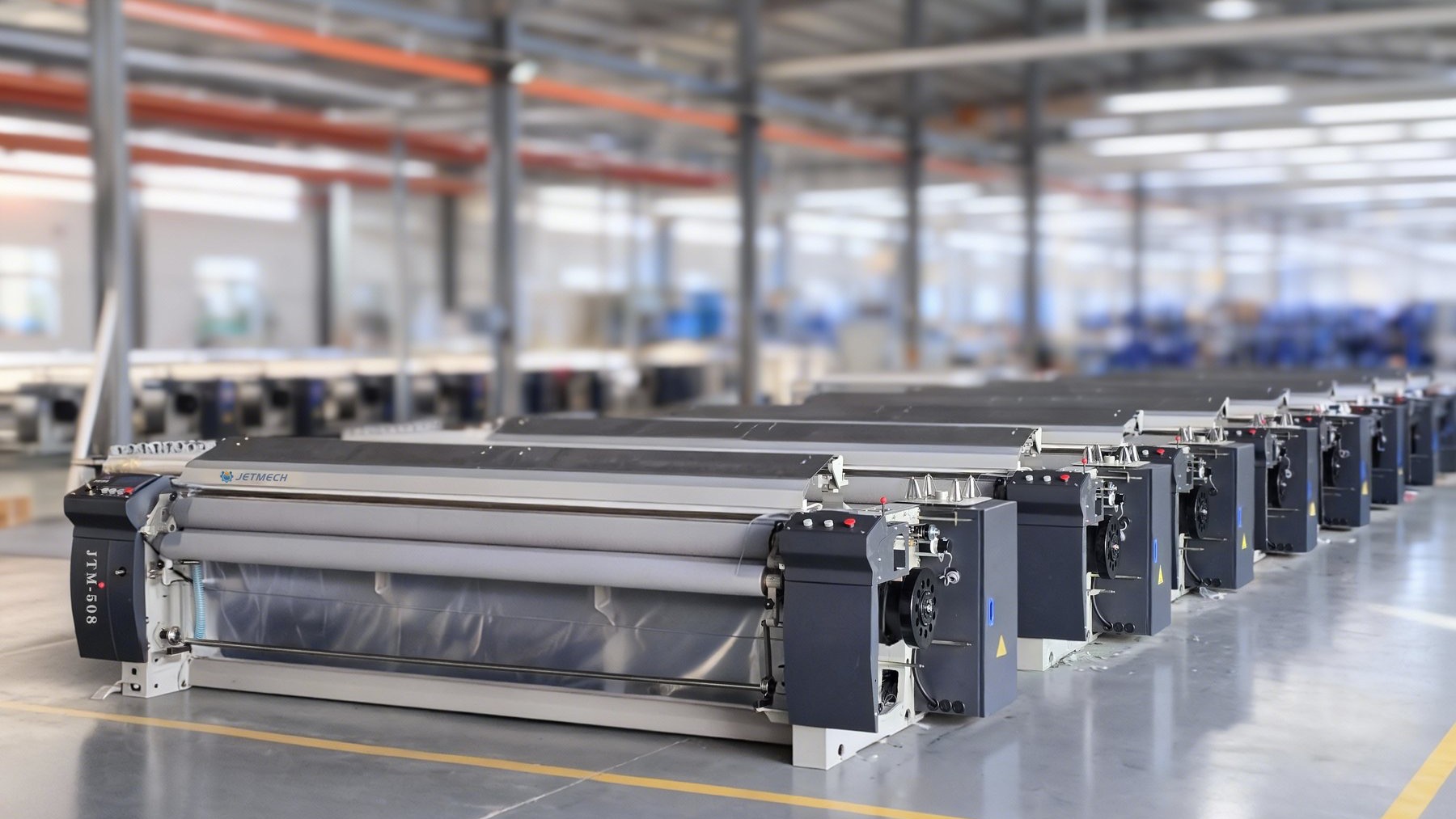
If your factory is purchasing a waterjet loom for the first time, start by understanding the complete weaving cycle. Stable production depends on the pump, nozzle, shedding, beat-up, edge-forming, let-off, and take-up systems working together.
WEAVING CYCLE
From the weft package to the woven fabric
The feeder measures and stores the required weft length, then presents it to the nozzle. As the shedding system opens the warp, the controlled water jet carries the weft across the reed space. The detector checks that the weft has arrived, the reed beats it into the fabric, the cutter separates the inserted yarn, and the leno devices secure the edges.
- Measured weft storage and clamping
- Synchronized shedding and water-jet insertion
- Weft detection, beat-up, cutting, and leno selvage
- Coordinated warp let-off, fabric take-up, and water removal
PUMP AND NOZZLE
How the water jet is generated
The pump cam moves the plunger through a suction-and-delivery cycle. Check valves keep the water moving in the correct direction, and the nozzle forms a focused jet that carries the weft. Pressure, flow, direction, and timing must suit the yarn, insertion distance, fabric, and running speed.
FABRIC SUITABILITY
Designed for hydrophobic continuous-filament yarns
Waterjet weaving is best suited to smooth, low-absorption continuous filaments such as polyester and nylon. Pure cotton and linen absorb water and are not suitable for this wet-insertion process. For a reliable configuration, the yarn condition, twist, sizing, density, width, and quality targets still need to be checked.
COORDINATED SYSTEMS
Stable weaving depends on the complete machine
The frame and drive provide the mechanical base, while shedding and beat-up form the fabric. The insertion and edge systems control the weft and selvage. Let-off, take-up, lubrication, electrical control, filtration, water removal, and drainage keep the process consistent. This is why a waterjet loom should be evaluated as one coordinated system, not as a list of separate parts.
Start with the fabric, not only the model name
Share your fabric construction, yarn details, finished width, weave, and target output. JETMECH will explain which systems matter for your project and why.